Most people enter home services as a job: a call today, a payment today. Very few are shown that the same trade can be a career with rising pay, fixed clients, and eventually a team of your own. This article lays out that path clearly, because the technicians who understand it are the ones who are earning several times more five years later.
The four stages of a home services career
Stage 1: Helper to independent technician
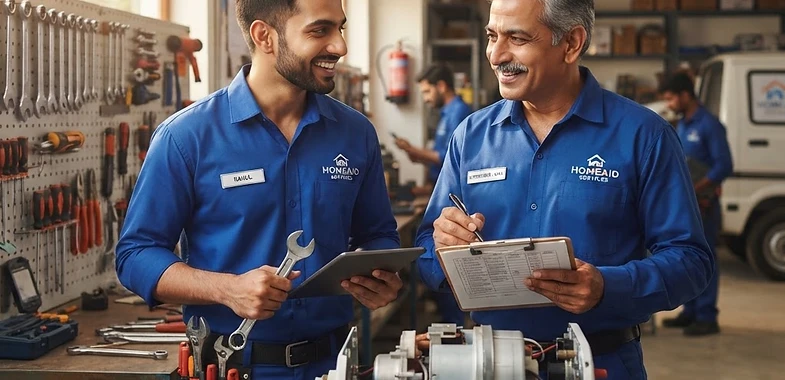
You start by assisting an experienced technician, learning on real jobs. The goal at this stage is breadth: learn the whole job, not one task. Carry tools, watch the diagnosis, and learn why a decision was made, not just what was done.
What moves you forward here: reliability. Arriving on time, every time, is the single fastest reputation builder in this trade.
Stage 2: Specialist with verified credentials
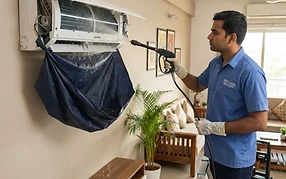
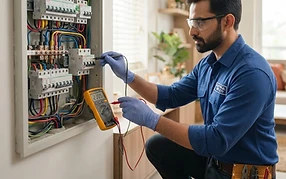
Once you can handle standard jobs alone, pick a specialism. Air conditioning, refrigeration, plumbing with concealed piping, inverter and PCB-level electrical work, or appliance electronics. Specialists charge more because fewer people can do the job.
At this stage, get your identity and trade credentials verified on the platform you work with. Verified profiles get assigned more jobs, and customers are far more likely to accept a verified technician at a higher price.
Stage 3: High-rated professional with repeat customers
This is where income stops depending on luck. A technician with a strong rating and completed-job history gets repeat calls and direct requests. Customers ask for you by name. Your calendar starts filling before the week begins.
What matters here: reviews and completion rate. Every well-finished job is an asset. Every abandoned job is a cost.
Stage 4: Team lead, supervisor, or business owner
The final stage is leverage. You stop selling only your own hours:
- Team lead at a service company, coordinating three to ten technicians.
- Independent business with two or three technicians working under your brand and your quality standard.
- Trainer or quality inspector, checking jobs done by others.
All three pay more than doing every job yourself, because you are being paid for judgement and organisation, not only labour.
The skills that actually raise your pay
Technical skill gets you in the door. These raise your rate:
- Diagnosis — finding the real fault instead of replacing parts until it works.
- Communication — explaining the issue to a customer in simple words, in Malayalam or English.
- Estimation — quoting accurately so a job does not turn into a loss.
- Documentation — photos before and after, and a clear invoice.
- Safety discipline — correct equipment for height and electrical work.
Certifications worth having
Formal certification is not always required in this trade, but it changes how customers and employers see you:
- ITI or diploma in electrical, refrigeration or air conditioning.
- Manufacturer training for specific AC or appliance brands.
- Wireman or electrical licensing where required by law.
- Safety training for working at height.
Add these to your profile with the documents uploaded. They are the difference between "a technician" and "a certified technician".
Why ratings compound
A rating is not a scoreboard, it is a pricing tool. Two technicians in the same city, with the same skills, can earn very differently because one has forty 4.8-star reviews and the other has none.
Practical habits that protect a rating:
- Confirm the arrival time in a message before leaving.
- Tell the customer if the job will take longer than estimated, early.
- Never add unrequested work without agreement.
- Photograph the finished job.
- Follow up after a large job to check everything is fine.
Common mistakes that stall a career
- Chasing only the highest-paying single job and ignoring repeat customers.
- Working without tools that match the trade, which limits the jobs you can accept.
- Avoiding written quotes because they feel formal, then arguing about the bill.
- Ignoring safety equipment until an accident happens.
- Never asking for a review.
Building a professional presence
Keep one profile with your photo, verified ID, trade, years of experience, service area and completed jobs. Keep the same phone number and respond quickly. In home services, being findable and reachable matters as much as being skilled.
QuickFIX Global profiles carry verification status, trade, experience and job history in one place, and completed jobs build a public rating that follows you. Technicians who treat the profile as their business card get direct requests instead of waiting for assignments.
A practical twelve-month plan
- Months 1-3: finish verification, collect the basic toolset for your trade, complete every assigned job on time.
- Months 4-6: pick a specialism and take manufacturer or ITI training where possible.
- Months 7-9: push your rating above 4.5 by focusing on punctuality and clean finishes; ask satisfied customers for reviews.
- Months 10-12: review your earnings per job, drop the lowest-value work, and start training a helper.
Home services rewards people who stay, learn and keep their word. Treat it as a career and the income follows the reputation.
Related reading: On-Demand Technician Jobs in Kerala walks through the practical next steps. Ready to start? Create your verified technician profile or browse open roles at QuickFIX Global.